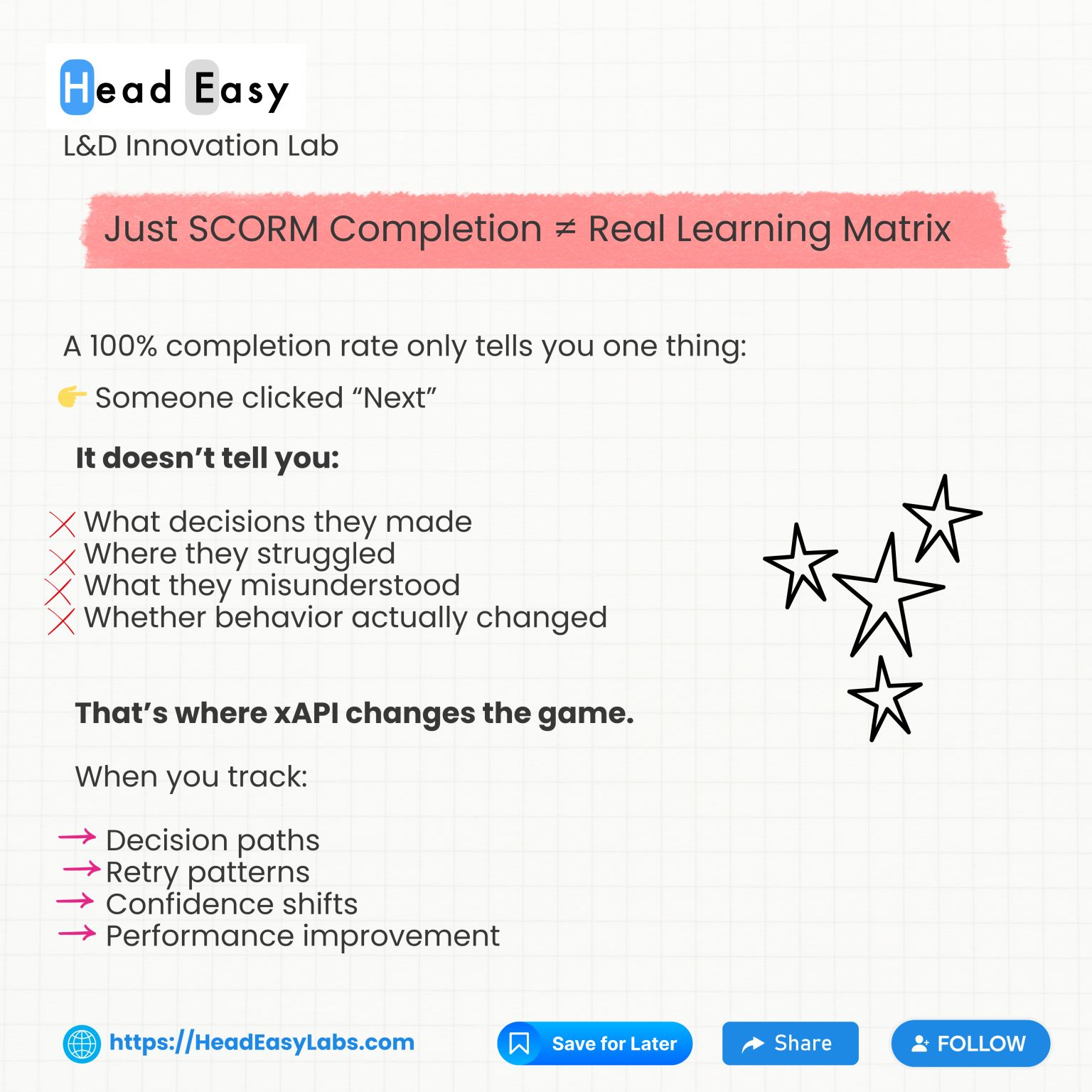
Picture a compliance training rollout that goes perfectly on paper. The LMS shows a 100 percent completion rate, and the quiz scores are clean. Everyone checks the box, leadership breathes easier, and the training looks like a win.
Then a real incident happens. The team still misses a key step, and the process breaks. The course was completed, but the behavior never changed. That is the gap SCORM cannot see, and it is the reason many learning teams feel stuck when they only have completion data.
SCORM remains the most common standard because it is dependable and simple. It records that a learner launched a package, finished it, and passed a quiz. For audit trails and compliance, that is often enough.
But the moment you want to understand how someone learned, SCORM goes quiet. It cannot show which decision was chosen in a branching scenario, which hint was used, or where a learner had to restart. It tells you the outcome, not the journey.
That is where xAPI begins. Instead of a single “completed” status, xAPI captures a stream of events that map the learning path. It can log choices, retries, timing, and even the context in which learning happened.
If SCORM is a receipt, xAPI is the story. It reveals how learners made decisions, where they hesitated, and which moments actually moved the needle. This is the learning matrix SCORM cannot produce.
In practice, the xAPI matrix shows decision paths through scenarios, retry patterns that signal confusion, confidence shifts before and after practice, and real performance improvements across attempts. It can also connect to real-world behavior, such as “completed a practice call” or “resolved a ticket without escalation.”
That is the difference between tracking attendance and tracking capability. One tells you the course happened. The other tells you whether the learning stuck.
What xAPI captures that SCORM cannot
SCORM is tied to the LMS package and limited to a small set of fields. xAPI is not tied to a single system. It can track learning anywhere it happens and store the data in a Learning Record Store.
That means you can track decisions, hints, errors, time spent, and the exact sequence a learner followed. You can also track workshops, coaching conversations, simulations, and on-the-job practice that never appears in a traditional LMS.
And because xAPI data is granular, you can map learning behavior to business outcomes. You can tie a specific decision in a role-play to later sales performance, or link a troubleshooting path to reduced support escalations.
Learning matrix snapshot
The matrix below shows the kinds of xAPI signals that help teams improve learning design and performance.
| Matrix signal | What it reveals | Why it matters |
|---|---|---|
| Decision paths | Which branches learners choose in scenarios | Highlights where judgment breaks down |
| Retry patterns | Where learners repeat steps or restart | Flags confusing content or weak instructions |
| Confidence shifts | Changes in self-rated confidence over time | Shows belief change, not just recall |
| Time on key moments | How long learners spend on critical steps | Surfaces friction in the learning flow |
| Performance improvement | Score lift across attempts or practice runs | Proves skill growth, not just completion |
| Real-world actions | On-the-job tasks completed after training | Connects learning to business outcomes |
Use case: sales enablement
A sales team completed a SCORM course on discovery best practices. Completion was high, but managers still heard weak questioning on calls. By adding xAPI to a role-play, the team tracked which discovery questions reps chose, how often they used a hint, and where they skipped follow-up prompts.
The data showed a consistent drop-off at one decision point. The content was adjusted, and managers coached the exact moment where reps were struggling. Win rates improved because the training finally targeted behavior, not just attendance.
Use case: safety and compliance
In safety training, SCORM proves that the module was completed. But when a simulated hazard was introduced, some learners still missed the warning sign. xAPI captured which hazards were misidentified, how long the learner hesitated, and whether they needed to replay the scenario.
The organization updated the content around those weak spots, then monitored the xAPI signals for improvement. The change reduced on-the-job incidents and created a clearer link between training and real-world safety.
Use case: customer support
A support team used a SCORM playbook course to teach troubleshooting flows. Completion was high, but escalations stayed flat. Adding xAPI to the simulation revealed that new agents often chose the fastest path, not the correct one, and skipped a key diagnostic step.
The playbook was revised, and targeted practice was assigned to the exact step being skipped. Escalations dropped and first-contact resolution improved, backed by xAPI signals tied to those decision points.
Use case: software adoption
A software rollout team used SCORM to track training completion. But the product team still saw low adoption of advanced features. xAPI events were added to the product itself, capturing actions like “created first report” and “shared dashboard with a team.”
The team learned which learning steps correlated with real adoption and which did not. Training was re-sequenced to match actual usage behaviors, and adoption climbed within weeks.
Use case: leadership development
Leadership programs rarely live inside the LMS. They involve reflection, peer feedback, and real coaching sessions. With xAPI, those moments can be captured as learning events: reflections submitted, coaching sessions completed, and real actions taken on the job.
This creates a credible record of behavior change, not just attendance. It helps leaders and L&D agree on which capabilities truly improved, and where more support is needed.
So, SCORM, xAPI, or both?
If your primary goal is compliance, SCORM is sufficient and easy to manage. If your goal is capability and performance improvement, you need the depth that xAPI provides.
Most modern teams end up using both. They keep SCORM for packaged delivery and reporting, then layer xAPI on top to capture the learning matrix that shows what actually changed.
The result is a clearer story: not just that someone finished a course, but how they learned, where they grew, and which behaviors improved in the real world.